



Ezra Pound’s Liberation: A Historical Overview
In 1958, a significant chapter unfolded in the life of poet Ezra Pound, marking an important moment not only in literary history but also in the intersection of art and mental health. Following years of confinement in an asylum, a United States federal court ruled for his release, recognizing the complex interplay between his mental health issues and his profound contributions to poetry.
Background of Ezra Pound
Ezra Pound, born in 1885 in Hailey, Idaho, emerged as a leading figure in modernist poetry. His innovative approach reshaped literature and influenced countless writers. However, during World War II, his controversial political views, along with his support for Mussolini, landed him in hot water. In 1945, upon returning to the United States, Pound was deemed mentally unfit, leading to his confinement in St. Elizabeths Hospital in Washington, D.C.
Life Inside the Asylum
During his time in the asylum, Pound continued to write, producing works that showcased his genius and complexity. Nevertheless, he suffered in silence, grappling with an extensive array of mental health challenges. His experiences within the institution fueled the debate over the treatment of individuals with mental illness, raising questions about the fine line between madness and creative genius.
The Legal Battle for Ezra Pound's Freedom
The legal fight for Ezra Pound's release was not solely a personal struggle, but a reflection of broader societal issues regarding mental health and civil rights. The case gained traction due to advocacy from literary figures and supporters who argued that Pound's confinement was unjust and detrimental to his artistry.
Federal Court Decision
On this momentous day in 1958, the federal court ultimately concluded that Pound should be released, recognizing that his continued confinement was no longer warranted. This decision was hailed as a vindication not just for Pound himself, but for many who found themselves caught in the often cruel and arbitrary nature of the asylum system.
Impact on Ezra Pound's Life and Work
After his release, Pound continued to write and engage with the literary community, although he remained a controversial figure due to his previous political affiliations. His liberation paved the way for renewed discussions about the relationship between art and mental health, encouraging a deeper understanding of artists' struggles and the complexities of their minds.
Fun Fact
Ezra Pound’s Influence Beyond Poetry
Aside from his poetic achievements, Pound played a pivotal role in mentoring a generation of writers, including T.S. Eliot and James Joyce. His contributions to the literary community extend far beyond the confines of his poetry.
Additional Resources
Recommended Reading on Ezra Pound
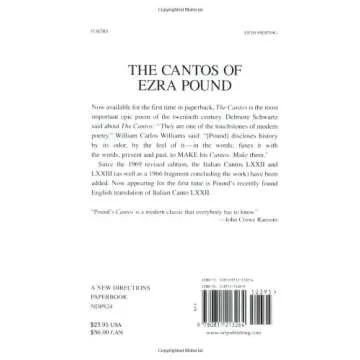
For those looking to explore Ezra Pound's life and works in depth, consider reading "Ezra Pound: Poetry and Prose", which offers a comprehensive look at his literary contributions, or "The Cantos of Ezra Pound", highlighting his most significant poems. Both works provide invaluable insight into his complex character and legacy.









 Continue with Google