


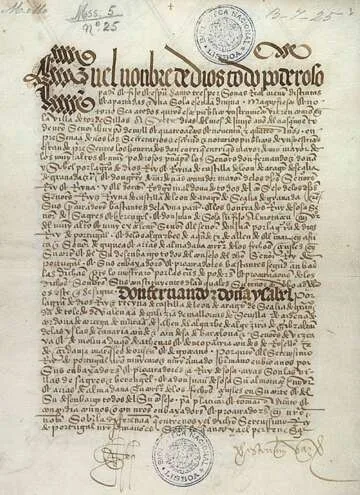
The Historic Treaty of Tordesillas
The Treaty of Tordesillas, signed in 1494, was a pivotal agreement between two of the most powerful nations during the Age of Exploration, Spain and Portugal. This treaty emerged from the intense competition for maritime dominance and colonization of newly discovered lands in the Americas. The treaty effectively divided the world outside Europe between these two nations along a meridian 370 leagues west of the Cape Verde Islands, a significant step that would alter the course of global history.
Understanding the Treaty of Tordesillas
Signed on June 7, 1494, in Tordesillas, Spain, the treaty was prompted by the discovery of the New World by Christopher Columbus in 1492. The Pope at the time, Alexander VI, sought to establish peace between the two Iberian powers by delineating spheres of influence. According to the treaty, lands discovered west of the designated meridian would belong to Spain, while those to the east would be controlled by Portugal. This division was not merely a matter of politics; it was a declaration that would shape the future of colonization, trade, and cultural exchange.
The Impact of the Treaty on Colonization
The Treaty of Tordesillas significantly influenced the destinies of both Spain and Portugal. While Spain secured much of South and Central America, Portugal gained access to territories in Africa and Asia, including Brazil. The division, however, led to tensions as other European powers, unable to conform to this demarcation, sought to challenge the treaty. Notably, the Treaty contributed to the rise of a global economy and the fervent competition that followed in the Age of Exploration.
The Legacy of the Treaty of Tordesillas
The long-term effects of the Treaty of Tordesillas continue to resonate today. While it was initially met with cooperation, the reality of international colonization soon unraveled the agreement. Other European nations disregarded the treaty, leading to conflicts and territorial disputes. Ultimately, the treaty became a symbol of European colonialism and its sometimes arbitrary decisions that disregarded the existing cultures and peoples of the divided lands.
Evaluating the Success of the Treaty of Tordesillas
Although the Treaty of Tordesillas aimed to mitigate conflict between Spain and Portugal, its effectiveness was limited. The demarcation line was often unclear, leading to disagreements and collisions with territories claimed by other nations. Additionally, the arbitrary nature of the treaty overlooked the indigenous populations, highlighting the disregard for their rights and sovereignty in the face of European ambition.
International Response to the Treaty of Tordesillas
In the years following the treaty, other European powers, such as England, France, and the Netherlands, began to enter the contest for colonies, often ignoring the line set by Tordesillas. This growing competition would result in fierce territorial conflicts and the eventual reshaping of colonial empires that recognized no boundaries established by Spain or Portugal.
Fun Fact
The Controversial Interpretation of the Treaty
Many historians argue that the Treaty of Tordesillas marked the beginning of modern international law as it attempted to resolve disputes over territory. However, its flawed execution also led to a legacy of conflict that contradicted the peace it sought to establish.
Additional Resources
Recommended Reading on the Treaty of Tordesillas
For those interested in diving deeper into this fascinating event, consider reading "The Treaty of Tordesillas: History and Legacy" and "1494: The Year the World Began". These works provide further insights into the treaty's implications and its historical context.







 Continue with Google